Total Pageviews

Wednesday, June 27, 2012

Happy Fourth of July--a little early

Stuart here....I just got back from a 4th of July party at the residence of the American Ambassador to Honduras, Lisa Kubiske.
This is Mattias Mitteman (sic) who is the Director of the Mission. I think that means he runs the embassy somehow. I got the picture becuase I love the suit (blue and white pinstripe, cotton suit!!!) and hope to get one someday.


I don't usually run around in the circles of the people who attended the party....politicos like, The Honduran President (speaking here), Supreme Court (of Honduras) justices, the mayor of Tegucigalpa, different ministers of the country, lots of embassy people, US and Honduran Military, press people, etc.

It was a good experience. Plus the food was great. They also had a really interesting presentation with the breads in actual bread bowls,

and bread cornucopias.

What I heard there, combined with the announcement of President Obama last week to not deport people brought illegally as children, esp. those studying in college, has really made me think and be a little conflicted.

From what I have gathered from my limited exposure to the news is that the Executive Branch won't deport people that are under 30, but have been in the US for a long time, and are in college or are studying and were brought here as children.

At first glance, that seems OK, until you realize it is an end-run around the 2-times Congress has rejected the DREAM Act, which would do the same thing. In short, it is another example of the President assuming Congressional power through executive order or through lassaiz-faire--non-enforcement of Federal laws. Either way, I think the acquisition of more power in the Executive is not good and was astonished at the way Pres. Bush used his power. Unfortunately, it continues and I am sure under a Romney Presidency (or Obama) more power will be concentrated in the executive, which doesn't seem to bode well for the Constitutionally explicit checks and balances.

On the other hand, after hearing the speech of Ambassador Kubiske and then that of President Lobos Sosa, President of Honduras, I was intrigued. He was very pleased with the announcement. He praised the US policy and was glad. Last Saturday the main headline in the paper in about 60-font was the announcement. It should affect about 8 million people in the US.

People in Latin America want to come to the US. While they aren't the fastest growing ethnic group (Asians are now), the opportunities in the US are huge. After living in Honduras and working closely local Hondurans, I have found that there are many that would LOVE to come to the US. As such, I am torn about what to think about the new US immigration policies. Ranae has written a little about how difficult it is to get ahead here, since it is really scramble competition--some get a lot, some get little and some get none.
But the opportunities there in the US, the peace that is there, the customer service, the comparative lack of government corruption, the clean water everywhere, pretty, clean farms, few razor wire fences on houses in town, etc. all make it a real paradise, despite the wonderful things that are also here in Honduras.

In any case, I am again reminded about how great it is to live in the US and the blessing it is to be from there. I am thankful to Congress for appropriating the money for the Fulbright Program that has and will forever change my family--improving their skills and outlook on US life. I am thankful for what the 4th of July represents. We do live in a great country that has in many ways influenced the world very positively. Happy 4th of July next week!
I put a bunch of pictures of Copan at this link at Flickr for your viewing pleasure.

http://www.flickr.com/photos/52577150@N07/sets/72157630320160380/

I hope you like them. I will try to put up more there and also two or three videos of the place. It really is a wonderfully, peaceful, strange, place.

I think of the Ammonihahites when I think of this place and how the trees have taken over.


Monday, June 25, 2012

June 25, 2012
A bit of “fleshing out” of our entry about Copan:
Abe: There was a game that they [the ancient Mayans] played, and whoever got the most points had to die. There were rock heads, one in the middle, and one on the side, and one on the other side. They had a ball made out of milk and rubber. They either had to bonk it with their shoulder, hip, or head. If they hit one of the rock heads with the ball, they would get a point.

Jack: The Mayans were short. The average was about as tall as me. They had a god called Chak, but it sounds like “Jack.” He was the god of rain. He rained out his nose. There was a king called 18 Rabbit. There was a pyramid that, if you yelled off the top, your voice could be heard all around the plaza. [The Mayans were skilled engineers.]

Henry: The Mayan city, Copan, was awesome. We saw ancient temples, altars, a game court, and old rock carvings. We went in a tunnel underneath a big temple. Some friends and I went on a zipline over the forest. It was fast, fun, and awesome. I got stuck 2 or 3 times.
There was an ancient king whose name was 18 Bunny. [In Mayan writing,] each line represents the number 5, and each dot represents 1. So to write his name, you make a stack of 3 lines [for 5—10—15] and then 3 dots on top of the stack of lines [for 16—17—18]. Then, next to the number, the Mayans carved a little picture of a rabbit.
My birthday was fun. We went to some friends who live in the mountains. Me, Jack, and my dad and Hermano all cut wood with machetes.

Aspen: We went to Copan, and what I thought was interesting was that the biggest Mayans were no bigger than 5 feet tall.

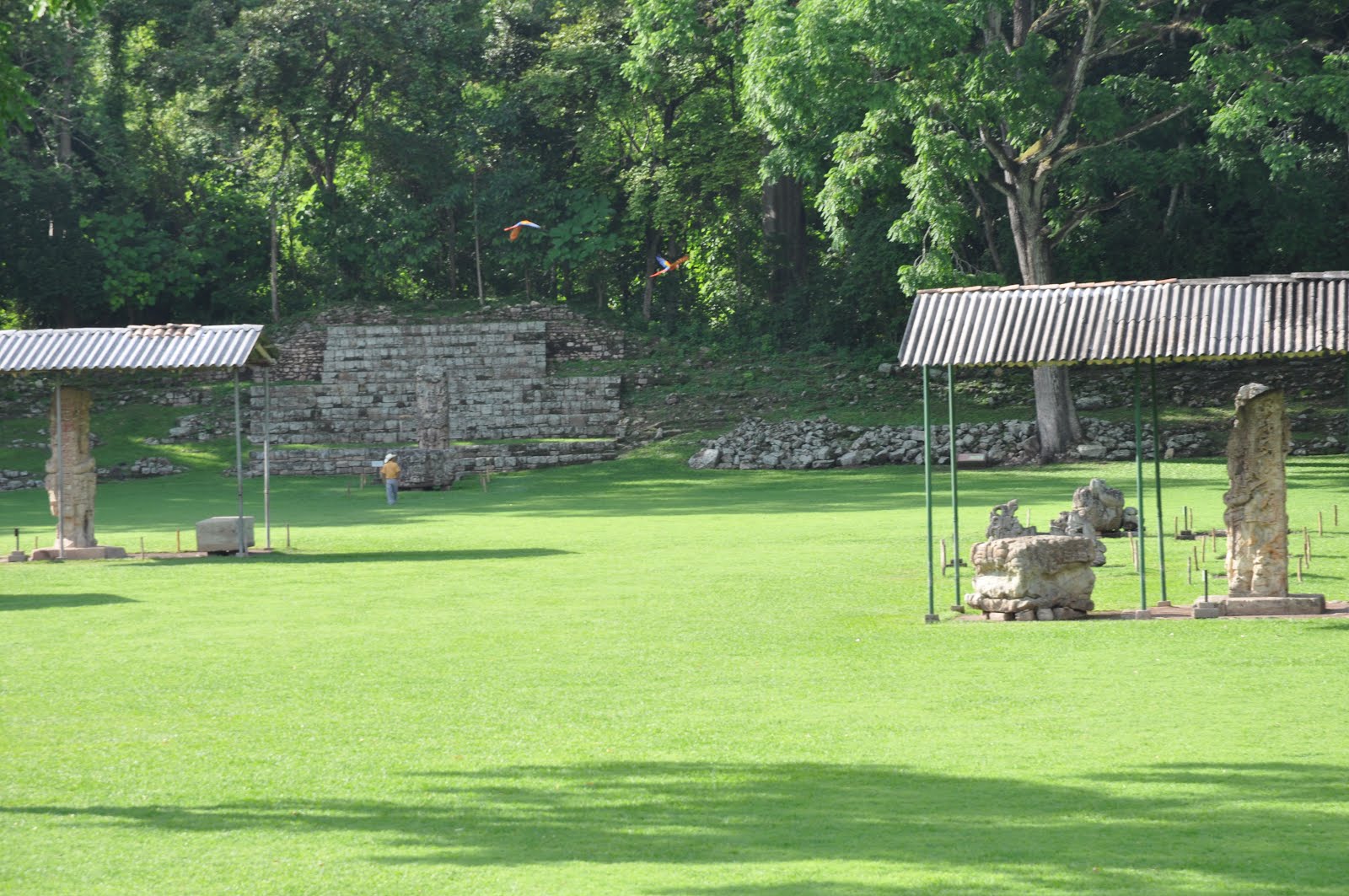
Ranae: For me, our day in Copan was satisfying and intriguing. I very much enjoyed walking amongst and on and through the ruins, seeing those great stone structures rising formidably from the jungle floor. All was quiet and amazingly serene. Once, this was a bustling city with cheering crowds, grotesque religious rites, artistry, slavery, and science. Today, it was quiet, the sounds of scarlet macaws and the wind muffled by the silent green grass carpeting the empty plaza. Great trees stretched toward heaven, anchored by gnarly roots to the ancient stone walls and steps. Certainly there is a feeling that even the greatest of human creation will someday by overgrown and slowly worn away by the unforgiving and innocent encroachment of nature. The trees don’t care which great kings carved their histories here; they simply grow silently and strong, slowly crumbling the carefully constructed stones, slowly crumbling the walls made with slaves’ life effort. I add Copan to my list of enriching experiences—my “wonders of the world” that have delighted my heart and filled my mind with awe.

We loved hosting our friends Hannah and Edwin for a week (and we are serious about letting them return the favor some day!). Their visit was full of energy and gave us the opportunity to share our Honduras. We walked through campus, swam, had coconut water, bought fruit at the fruit stands and water at the mercadito, played soccer, ate lots of beans, cleaned our little chapel, traveled to Copan, visited the Terceros, bought souvenirs at Valle de Angeles, got stuck in Tegucigalpa traffic, went to church, celebrated Henry's birthday, and watched a few movies.

Edwin was a roommate of Stuart's from BYU. They share the same birth date and several (astrologically influenced?) intriguing similarities. Their conversation never seemed to stop. It was nice to talk shop, American style--politics, mission memories, book reviews, current events. Edwin brings a breadth of experience from the "other side" of life--as in, non-academia. Through our conversations, Stuart and I got a crash course in economics, business, and real estate. He is good at recognizing the good in others and pointing it out to his daughter. He is good at time management, delegating, and gobbling up opportunities. He gave us new things to think about, which is something to be grateful for. And Hannah certainly wins a gold star for being a good sport--not only did she make a long road trip in an overstuffed car, she did it with a family of strangers! She weathered the experience well, cheerfully encouraging the others and venturing into our car games. Our children were happy for her fresh and pleasant company. I was happy for her offer to help in the kitchen. Maybe her experience here will convince her that some bananas are worth eating!

Henry’s was the fourth and final birthday we will celebrate here in Honduras. How do you turn 11 in Honduras? Spend the day with your family and friends at a rustic adobe-house farm, then come home for ham and cheese sandwiches and Grandma Waisath’s Chocolate Cookies. We played “Pin the Guy on the Zipline,” “Murder in the Dark,” and “List As Many Things As You Can Think of to Do with a Package of Ramen.” A great time was had by all. I love it when all the family is gathered in laughter and joy.

Summer vacation has started in earnest, and we have been busy with the openness of no schedule. The children and I go every morning to the pool for “family swim team.” Even Calla jumps in and swims laps back and forth across the pool. (I hold on to her, but she is a little powerhouse of a swimmer.) She swims and smiles and laughs all the while. Today she said, as she left off from the kickboard and started using her arms, “I’m like a mom!” After swim team, and with the exception of the soccer and horse riding lessons that happen on Mondays and Tuesdays, we spend the day mostly at home with ourselves. We don’t really have a car that we (I, myself) can drive around, and we don’t have many places that we can go. The children were impressively industrious and creative last week, making birthday gifts for a friend, playing soccer, playing Frisbee, swimming, drawing on paper and computer, talking with Miriam, and helping to make cookies. Last week was the kind of week you long for when you are caught in the hustle of life during May. However, I expect the slow schedule will become burdensome soon. We will have to find other things to do, places to go, people to see in the remaining weeks of vacation we have here.

Today Miriam finished the dress she was sewing for Calla. When we were in Kansas, I told some women at church about Miriam learning to sew and trying to start a little sewing business. A handful of women generously donated some fabric they didn’t need any more. Using one of the pretty sheets I (an American) brought back from a German ice skater living in Kansas, here in Honduras Miriam has learned to sew a dress—how to use a pattern, cut out the pieces, put them together, and follow the instructions from the pattern. What an amazing mix of resources from around the world! What a cool accomplishment for Miriam! What a cute dress for Calla, who had outgrown the two dresses we brought for her from California! How fantastic is that?

For all interested blog readers, thank-you for keeping up with us. We are so thankful for this opportunity to be here. We feel the closeness of the end of this experience, which makes us both anxious to return home and determined to finish up the goals we have made for ourselves here. I know the next six weeks will go quickly. I pray they will bring continued safety and health and learning.

Sunday, June 17, 2012

Returning slowly

We made it back from Copan. Edwin and his daughter Hannah came to visit and for the last week we have traveled around Honduras. It was great!

We will post some things of that trip.

Some highlights include:
Free-flying scarlet macaws--that was amazing!
18 Rabbit or dieciocho Conejo
the Mayan ball court
the cool mayan king names, like shell smoke and the Jaguar King
A tigger sculpture (stand by for the pictures of that one!)

School ended and Jack is a Renaissance Man
Tunnels carved underneath the main top part of the pyramids

Liquados at Comedor y Pupusaria Mary (licuados are water or milk shakes made with fresh fruit and ice). A comedor is an 'eatery' and a pupusaria is a 'pupusa store'.

Making it safely through 4 police checkpoints and navigating 7 hours across the Honduran countryside and getting lost (a little) in San Pedro Sula.

Ranae, Stuart, Calla and Abraham all got sick--some upper respiratory disease and a fever and rash.

Oropendula birds and nests.

We thought we'd save some money and not get a guide but we decided to get a guide (Armando) and it was great and the whole place really made sense after that!

Henry's 11th Birthday celebration with Grandma Waisath's famous chocolate-coconut cookies and his hour-long ride on a zipline through the "rainforest" (technically, secondary or tertiary forest)

Giant cedar (Cedro or Cedrela species), ficus, and Ceiba trees growing in the Mayan Copan Plaza and also on the Pyramids.

Riding 14 hours in the car, sometimes with out seatbelts!

Buying a giant banana cluster for $1.50 and eating it for 3 days.
Buying freshly picked pinas and then eating the sweetest, best tasting pineapples later on.

We saw a group of men plowing with 2 oxen and then planting beans or corn right behind the plow.

Good conversation with Edwin.

Watching Soccer (Honduras vs. Canada and Brazil vs. Argentina) in the hotel in the qualifiers for the Copa Mundial

Swimming in the hotel pool that had a nice shallow end.

Learning about the rain god Chak (or Jack as it sounded to us) who rains by sending water out his nose. That was a huge hit with one of our party. Maybe it will become his mascot from now on!

And more things we can't think of right now.

We are happy to be back into the groove, a little bit and looking forward to the next 54 days we have left!

Monday, June 4, 2012

....We've been away from "home"

We haven't posted in a while...as you may have guessed.

We have been in Missouri, Arkansas and Kansas attending the funeral of my Father, Dan Wooley. He died on May 23, after 60 (on May 10) years of marriage to my mom.

As with all people, we expected he would die someday. He was progressively sicker as this year went along and suffered from a number of ailments. His death brought him relief he had been seeking for a long time.

On a happy note, we were able to see a lot of cousins and siblings

at the funeral and events. We decided to stay for a while (about 9 days total travel time) to take advantage of being in the US, since it cost us so much to come here.


I spent a few days with my mom, post-funeral, trying to take care of the myriad issues that need to be taken care of when older people die. Credit card charges, pension disbursements, notifying federal (bureaucracy) agencies and trying to resolve basic issues, like internet access in the assisted living place for my mom. That only took two days of repeated meetings. More meetings are necessary to complete other issues, but I had to return and leave them undone.

We are grateful for and believe in the effects of the Atonement of Jesus Christ. As such, death, while a negative, is also not fearful. Indeed, we are comforted to know that good folks like my Dad, that die enter into "a state of rest, a state of peace, where they shall rest from all their troubles and from all care, and sorrow."

The service was great and it has been fun to be staying with my sister in Kansas. Two of her children are the same ages as our two boys. They are fun-loving guys and are really good Wii players and are a hoot. So everyone has been having a good time. Plus they have a big house ad so we've been able to spread out a little bit, which has been good. While I was with my mother, everyone else went to Liberty Jail and have had that experience.

We'll be heading back in a few hours after watching Phineas and Ferb...one of the better cartoons on TV. Then, back "home" to Honduras, mangos, good bananas, Miriam, good pinto beans, platanos and teaching English class.

We'll get back with other posts later. We're excited to have some visitors coming this weekend and will other adventures next week to write about!

Monday, May 21, 2012

Good news and bad news (about a tree)

May 20, 2012


Aspen has been taking horseback riding lessons on Mondays and Tuesdays--$10/lesson or $70/month—one on one. It is pretty cool and she loves it. She was a little sore at the beginning, but that little young body is strong and she is not sore now! The boys also played a soccer game on Tuesday and won, finally, against a team that usually beats them.

Jack: On Friday a bird pooped on me. [surely it was a cool tropical bird with neat plumage!]

Ranae: We hung up mosquito nets around each of the children’s beds, as much for the plague of ants as for the mosquitoes. (The ants and termites are in their season of dispersal—winged members of their colonies are emerging and flying away to start new colonies. The colony of ants that lives in our living room wall has sent forth hundreds of winged ants into our home. The other afternoon the air outside was filled with thousands of termites.) This is a shot of the light during the onslaught of ants.
The next day (this morning, the light fixture had a ring about 3" wide of dead winged ants.


The bad news is that on Wednesday, upon returning home with Stuart (after a morning of collecting data on his mahogany trees), we found a handful of strangers sitting around the outside of our gate. They were indeed simply sitting on the grass, a few on either side of the entrance to our yard and driveway. Driving up to them and between the two groups of them gave me a nervous feeling in my belly. Who were these men? Why were they hanging out around our house? We found the kitchen door closed (we always leave it open). Miriam met us at the door, likewise uneasy. She said the men had been there most of the morning. When she had asked them what they were doing, they would not give her any response. She had shut herself and Calla up in the house, hoping all was well.

Stuart went out to talk to them and then to our landlord’s son, Fernando, who lives next door. The men’s story unfolded, and that’s where the good news comes in.

The good news is that these men were from a little village down the highway called Maraita, and they were at our house for an exciting project. Their town has no electricity. The townspeople struck a deal with the energy company, that if the town would supply the labor to put up poles and string up the wires, the energy company would start service to their town. These men were trying to prepare the way for some of those electricity wires. They needed to trim some branches from the magnificent Guanacaste tree in our yard. They had machetes and a bottle of soda; they were waiting for someone who was going to bring a chain saw, and the soda helped the hours pass more enjoyably.

But then there is more bad news. The men stayed for much of the day, still waiting for a chain saw that never showed up. The next morning they returned, and the chain saw arrived. A young man (maybe 16 years old or so) climbed up in the tree, barefoot, and started hacking with the chain saw. He was not a skilled arborist. The glorious Guanacaste tree was badly injured. The young man cut each branch near its base, and the weight of the entire branch as it separated from the tree ripped off long jagged sections of wood. The branches dropped on the existing power and communication lines, dragging them to the ground. The branches dropped on the rock wall that surrounds our yard, bringing down a section of it. The slope outside our yard was full of Guanacaste branches. It was a mess. Fernando talked to the men and told them they needed to repair some of their cuts on the tree and clean up the branches. Though they did spend the afternoon hacking the branches into stackable pieces with their machetes, we are still waiting for them to come back to finish the job and repair their damage. I fear our landlord, who is traveling in South America, will not be happy to see the state of the yard and tree. Even the fact that the cuts were made for a good cause does not excuse the manner in which the job was done.

Which leads me to another thought: Living here gives us the opportunity to experience life in a more “wild west” or Montana sort of way. The structure of society is more primitive, with fewer laws than in the U.S. (particularly California) and less enforcement of the laws that do exist. There is less imposition of the needs of the society as a whole on the life of the individual. There is some greater freedom, in that we can make more of our own choices without government making them for us. But there is also some loss of freedom, in that the more primitive society offers fewer opportunities to choose from. Each person is left to act for himself and demonstrate what kind of person he is.

And we have met so many wonderful people, who are trying their best to do good and who live happily and simply and generously.
(A plumeria blossom--it is about the size of those old Kennedy 50 cent pieces or an Eisenhower dollar coin).


The day of the Guanacaste slaughter was the day Miriam brought some leaves from her platano (banana) tree so we could make tamales. They were easy and delicious. When Abe came home from school that day, he started visiting with Jorge, the groundskeeper/maintenance man in our little compound. Abe did not want to leave Jorge and come in for lunch, so we invited Jorge to come join us for lunch, too. Jorge, Miriam, Stuart, Abe, Calla, and I had a pleasant lunch of fresh tamales and fresh mangoes from our tree. We enjoy these friends.

Abe: Mom says, “Abe what did you talk about in [your class ] at Church today?” Abe said, sort of indignantly and matter-of-factly, responded, “I don’t know. I didn’t understand anything. They were speaking Spanish the whole time!”

Stuart: This week I didn’t write down as much but there were a lot of neat things that happened, I just can’t remember them all. Jack and I have gone to Teguc twice this week. One time was Tuesday for the commemoration of the Restoration of the Aaronic Priesthood by John the Baptist on May 15, 1829. We went to the site of the new Tegucigalpa Honduras Temple, which looks great, but you can see it is still clearly under construction. I wasn’t sure the neighborhood we’d be going through and being in, so I left my camera home. But if you images.google.com the Tegucigalpa Temple, you can see pictures of it. It is always a sight to see that lifts your spirits and great good will come to Honduras once the temple is here and the people begin to go there and become a temple-going people.
On the way back from the temple, along the highway from Teguc, we cross some pretty high elevation, just nearby the cloud forest. As such, it can get really foggy. Tuesday night, it was really foggy. Compounding the driving problem is lots of curves, no good white line on the right, and the tint on the window is VERY dark—making driving at night while looking through the tint impossible. So, I slowed down very slow and we followed a moto.
Like Ranae mentioned last week, the highway from Teguc to Zamorano has 3 major breaks in it where the road is dirt/bolders/gravel. These are areas where there have either been landslides (2) and the road hasn’t been repaired, or it is place with regular running water, so the asphalt disintegrates (1 place). Each section is about the same length—about 150’ or so. That night, practically in the center of one of them, a truck about the length of a mid-size U-haul truck was stranded. Its cargo space was made of slatted metal sheets, and it has an open top, though mostly covered by an olive-colored canvas tarp. It had broken down…literally. The cargo space, fully loaded with sandia (watermelon) somehow (the weight maybe?) had broken off of the truck chassis and was leaning precariously to the side, as if it were going to tip over. Think of a large, sandia-filled box, tipping off to the side. The clever drivers had shored-up the container with four large poles that were keeping the entire load from slipping off the truck chassis. The poles extended from the truck into the opposite lane essentially, making the area a single, narrow-lane passage. At night, in the fog, with the tint, I was a little nervous passing by the truck, as the single lane fell away about 40’ down and then a long steep slope going down a long way into the trees. Needless to say, we made it by the sandia truck and a few days later, when we passed by that spot again, there was no sign of it. The situation with the sandia truck did remind me of the sandia truck in Richard Scarry’s Cars and Trucks and Things That Go book—a sandia truck overturns on icy roads and the animal drivers are scurrying around to pick up the watermelons that are rolling down the road.

henry is ready for anything, even in bed!

We had another YM/YW activity at the Stake Center in Teguc on Saturday. It was for training for the youth to get them to do Family History work. One thing about these meetings here in the Stake, is we often have a visiting Seventy there. One way to think of a Seventy is a person who is asked to serve in the region as a liaison between the local folks and the Church HQ in Salt Lake City. In the US, it is rare that a Seventy attends these kinds of meetings and usually much of the work there between local folks and a Seventy is done via telephone, email or by letter. Here Seventies are present at a lot of the stake-level meetings we attend. I told Jack he has probably been to more meetings with General Authorities in the time we have been here than I have been in the last 10 years. That might be an exaggeration, but the general authorities and Area Presidency play a more visible role in the Church here than in the US.
One more note….mango season has arrived in the Yeguare Valley! Yeee Haw!! I am pretty happy about that. We began harvesting real, ripe, tasty mangos from our tree in the backyard this past week. They are coming on pretty fast, so we have to be diligent and eat them as they come in…what a shame. This year has been a down year for mangos here so there actually aren’t a lot of trees with mangos, which is the real travesty. Last year people were up to their ears in mangos. So maybe in a few years, mango season will be huge again—too bad it wasn’t this year!


Monday, May 14, 2012

Possum, Mother's Day, Gualaco, Pupusas


This week has been a good week full of interesting adventures! A few highlights include, swimming with the Mujeres Jovenes who came for swim lessons, chasing and catching fireflies at night, seeing amazing cloud-ground lightning very near the house, a possum, making crepes for Mother’s Day celebrations, Mother’s Day beginning on Friday at the school and ending Sunday, Stuart drove the 5 hours to Gualaco, Olancho and back, and rain nearly every day.

Stuart: The exciting thing for me was going to Olancho on Thursday and seeing many interesting things along the road going/coming.
I kept my camera on my lap and took more than 500 pictures on the way back. I deleted many when I got home, too! I stayed Thursday night in a literal “flea bag” hotel that indeed had fleas and was pretty hot. It cost me $52 total for 8 gal of diesel ($4.30/gal) and a night at the hotel ($10). I will post many of them on a Flickr page so you can go there and see them. Follow the URL (http://www.flickr.com/photos/52577150@N07/7196494128/in/photostream/) and you can scroll through all of the pictures posted there. Or you can just see the Honduran pictures here (http://www.flickr.com/photos/52577150@N07/sets/). I hope they will give you the flavor for the country even if some of the shots are little blurry.

Work progresses and I have been teaching 2 online classes from here. They are ending this week and I have to finish up grading and finalize the grades. I will be teaching one more in the Summer term which begins around the 2nd week of June until mid-July.
On Wednesday night, the electricity went out (again!) and so the whole neighborhood was dark. Lightning was abundant across the valley.


The fireflies were so abundant and active, the whole yard was filled with little greenish-yellow lights.

I was asked to teach English to the third-year students. These are students that have passed the TOEFL and need help with conversation and refining their English to the level they really need to speak to people. I have never taught English so I have to come up with something for 1 hour/day for 3-days a week every even week from June to August. If you have any good ideas of cool English things to share with the students, let me know!

Happy Mother’s Day!

Aspen: On Thursday we heard a dog barking in the front yard. And it was shaking something around in its mouth. So we went to go see what it was and it was a possum mother and then the dog ran away. So we went outside and the mother possum was laying down and had big blood patches on her back and by its ear. By it we saw something moving around by it that looked like a snake. When we got closer, we saw it was a baby possum that had its eyes still shut. We picked up the baby possums with a palm leaf and put them with their mom. The mommy possum kind of stood up and pretended she was limping. Then she walked up to her hole in the rock wall. Then we got some old food scraps, because they eat whatever a pig eats. In the morning I went out to see if the food was still there. It was still there. That means that the possum wasn’t there, because if it were there, it would have eaten the food. I think the food is still out there right now.

Henry: On Wednesday night, our family went out in the yard, and the whole yard was sparkling with little lights; sparkling with fireflies. We went out and caught some fireflies.
On Thursday, we heard a dog barking in our front yard. When we went out to see what it was, the dog was gone. Once the dog left, we saw that it had been shaking a mom possum in its mouth. It has blood spots all over it. Since the dog was shaking it so much, the little babies got shaken out of its pouch. Some were so young, their eyes weren’t even open. We collected the babies and put them on the mom. The babies held on to the mom. She got up and limped off into the rock wall [that surrounds our house].

On Friday, we celebrated Mother’s day. Jack and I got up at 4:45 am to make breakfast for our mom. We made an omelet, crackers, Crystal Light® and star fruit (albaricoque). We took it to our mom at 5:25 because she usually wakes up at 5:30. For lunch at school, most of the moms came. We played Bingo with them and I won all the 3-6th graders, I won one of the rounds. I won a snickers candy bar.

On Saturday, we went to Teguc. When we came home the young women (YW) came over so we could teach them how to swim. But when they came, a storm was starting with lightning and so we taught them how to make crepes. Then when the storm stopped, we went swimming and taught them how to swim.
One time at the pool, my dad was throwing up Abe out of the water. All the YW were watching to see how high Abe would go, and when Abe came up out of the water, his swim trunks fell all the way down to his ankles.

On Sunday I made crepes before for breakfast. After Church, I made a triple batch of crepes with Jack and Dad. Crepes are very yummy [though it does depend on what the filling is]. Moist rodent.

Abe: I can’t remember anything. We had two parties this week. I got candy and soda. Seeing the possum was a little scary. One time it blinked its eyes and it did its teeth like this [it bared its teeth]. I am done.

Jack:,
Mother’s Day here is the same [date] as in the US. Me and Henry got up at 4:45am to make breakfast in bed for my mom. We made an omelet, crackers, Crystal Light® and star fruit. I shredded my fingernail in the cheese shredder.
There was a lightning storm and the power went out about 6 and came back on the next day about noon. That night we caught fireflies in the backyard.

Yesterday the mujeres Jovenes came over so we could teach them how to swim. We had about 10-15 minutes to play around at the end. Dad was throwing Abe up into the air and Abe’s swim trunks fell all the way off as he shot into the air from the water. I was just diving in when he did it and I came up out of the water and I was laughing so hard, I had to go over to side so I could breathe.

There are some kids in my class who went to Tegucigalpa Friday for some athletic thingy, and they won a lot [of events] and 4 qualified from my class. One from 5th grade and one from 4th grade. On June 3rd they are going to El Salvador for the Jr. Olympics for little guys.

We have been making crepes. We made a lot today. They are very yummy and some are purple (but we ate all of those). We are filling them with green pineapple sauce that looks like snot, kind of. But it tastes way better. We put in 1 drop of blue food coloring [into the pineapple puree].

We heard a dog barking and after dinner we went to see what was happening. We came out and looked and a dog was shaking something around. It was a possum and then after the dog left, we saw something that looked like a snake, but it was a baby possum. We scooped up a total of 4 babies and put them on their mom. Then their mom got up and walked away, even though she was totally hammered [by the dog shaking her].
There are a lot of termites flying around our house. Today during church I went home with my dad to make jugo de sandia (watermelon juice) for the mothers at church.

Mom: This week (in a role reversal) I showed Miriam how to make pupusas, based on my experience of watching them being made at the school’s carnival last week and at a street-side stand in Valle de Angeles. (Pupusas are like stuffed corn tortillas, filled with cheese or beans or meat mixes. They are a Central American food, especially typical in El Salvador. Nowadays, they are available for North American consumers at Costco!) (But authentic, freshly made pupusas are even better than the Costco type.) Our pupusas were delicious. We’ll have to try again to perfect them.

The main highway to Teguc has a few sections that have been badly damaged by landslides—more precisely, have been ripped off by landslides. Apparently the damage occurred years ago, but the sections have yet to be repaired. In some sections, the paved road gives way to dirt road for a few dozen meters. In one place, the pavement on the edge threatens to give way to the cliff below; if you drove too close to the edge (with no guard rails or good lighting) you would careen off into the abyss. Sometimes there are men who stand in the road, shoveling dirt into the holes to fill them in, signaling for drivers to pay them tips. This is one example of resourceful people trying to make work for themselves to earn a lempira or twenty.

As we drive, I like to look at the adobe houses, plastered white with brightly colored wooden doors and square windows cut into the walls without glass or screens. The red tile roofs and banana trees, the laundry on the line outside and a sampling of family members somewhere outside in the yard and maybe a horse or cow or donkey tied up outside—all these things are the typical things we see as we drive to Teguc.

The children were thoughtful and generous in their Mothers’ Day tributes. I love being their mother. I enjoyed very much the program at school on Friday—I got to go eat lunch or morning snack with each child and then play a few rounds of Bingo. We were serenaded by Mr. Carlos, the music teacher at the school, whose singing was highly acclaimed and did not disappoint. The teachers handed out cake and tres leches (a kind of pound cake with milk poured over and a caramel sauce on top). The time with the children this weekend has been sweet and happy and satisfying. They are fine people.

Monday, May 7, 2012


Stuart went to Florida this past week to work with some collaborators at the Disney Animal Kingdom.

The project is to see how to reduce the amount of iron intake in the diet of large mammals, like black rhinos. He got to see, up close, black rhinos, which are seriously endangered. They are so HUGE and have a prehensile upper lip. He couldn’t take any photos due to regulations about being in the non-public areas of the Disneyworld.

Needless to say, they are very impressive animals.

He also downloaded (from Amazon) some movies to freshen-up our current collection. I was surprised that I wasn’t as excited to be in the US as I thought I would. Maybe it was because I missed everyone here (in Honduras) and wanted to get back here to be “home” with everyone. I suppose, “home” is really where your family is, even if it is long-term temporary. For now, Honduras is our home and we love it and it is great to all be here, together. While driving to the airport the morning I returned, I heard a long article on the BBC about Honduras with the oft-quoted statistic that Honduras is the murder-capital of the world, 87/100000, which in comparison to Mexico (16/100k) which so many people think is so bad or the US, which many European countries regularly chastise for its high rate (4/100k). Despite hearing the article on the radio on my way to this “dangerous” country, I was not worried, nor afraid—it just felt good to be going home. We have been blessed with total peace and tranquility up to this point.

The children went to a Primary (children’s organization at Church) activity at Hermana Elsa’s house. We hiked up a steep rocky trail to the green house of Hna. Elsa. We were amazed by the view of all of the Yeguare Valley and Jicarito. From the hammock on her porch, Hna. Elsa can watch the sun rise in the morning, shine over the university, the watermelon farms, and the sugar cane fields, and set over Mount Uyuca in the afternoon. We ate spaghetti with lots of milky sauce (it might have had mayo in it!) and strips of ham in it. After playing a delightful round of Pato-Pato-Ganso (Duck-Duck-Goose), we managed the steep downhill hike back to our car, happy and full. And apparently our guts have adjusted to the new land; none of us had any digestive trouble after the dinner.

We knew we would find lots of soccer here, and we do. Along the highway, there are a few patches of flat dirt where children have constructed crude goals out of three branches. There are several cement soccer “canchas” as well, including some at the school.

The boys use our empty front room with its tile floor for an indoor cancha. Soccer matches occur nearly every day, if not several times a day in this room. We also play tag there among other things. We (Ranae and Stuart) think a room like that is a must wherever we move, eventually.

We found a huge toad at Aurelios (our dueño—landlord). It was bigger than Henry’s or Stuart’s hand—maybe the size of a 1kg yogurt container. It truly was the largest toad any of us had ever seen. It could have eaten kittens. It hopped around and Henry touched it…it was dry and Henry has no warts to speak of today.

Jack and Stuart went to a “Super Saturday” activity at the Uyuca Stake Center in Teguc Saturday. The “Stake” is a region of about 10-15 congregations. Youth 12-18 could attend. It was really fun, even though Jack didn’t understand everything. He ate marshmallows, and spicy salad (encurtido) that goes along with the tamales we had afterwards. They also had tamarindo juice to drink, but neither Jack nor Stuart ate any. Jack played the balloon relay—you carry a balloon between your legs for about 40’ and then put it into a bag. If you drop it, you have to go back and start again. He played that a lot. He also played a game where you have to put a shirt and pants on (girls had a skirt to put on) while keeping your balloon in the air. Mostly, the girls won this one, since it was nearly impossible for the boys to put on jeans over their clothes in the time it takes to keep a balloon in the air.
They also had a fruit eating contest…who could eat the most in 1 minute. Stuart was recruited, but he lost. But it must be noted that the fruit was fabulous! It was two 1/4s of mango, slice of watermelon (sandia), two rounds of pina (pineapple), 1 regular size slice of melon (cantaloupe), and 1 banana. Stuart’s strategy was really to make sure to eat the fruit he liked the most that was also the rarest—so he didn’t make it to the banana. He noted that while the fruit appeared clean and fresh (and tasty!!) the bowls where the fruit were placed had already been through about 10 rounds of eating contest. The juice in the bottom was surely contaminated…I can hardly write about this!

At the school on Friday, it was Family Fun day with lots of games (each grade k-6 had an activity) and there was lots of local food for sale. You had to purchase a chance at each game and also purchase the food. The money went to the school. We contributed our pile of money by eating lots of pupusas, tamales, empanadas of meat, soda, paletas, natural fruit juice (passionfruit, mulberry, nance, orange and one other juice) and of course, hot dogs, which is what all the children wanted! However, Jack ate a few pupusas, because he loves them. We budgeted our activities and food purchases, and stuck within that budget (This is here for the Jones family) and everyone had a great time. We even had a little money left over, so our budget worked nicely. We got to play with water balloons, teeny water guns, walk across a tight rope, and throw wet sponges at the teachers. We met another Fulbright guy who has been living about 1 km away at the house of a student in Jack’s class. He is a public health student from NYU.

Here we have been loaned a Diesel Toyota 4-runner. It is a great car and we are blessed to have it. The arrangements made to get it were extensive and much of the reason we have it is due to a good Dept. Chair who worked a lot for us. While Stuart was in Florida, Ranae had to fill it with fuel. In the US, the diesel pumps are usually green and the gas ones are usually yellow. Here it is the opposite—diesel yellow, gas green (Foreshadowing….). Ranae went to get fuel and put in 4 gallons of regular unleaded gas into the diesel Toyota. Thankfully, she called for help, and Reiniery came to the rescue, getting the car to the campus mechanic. The draining of the fuel will cost us $35 (surely the lowest mechanic bill we’ll ever have).

On Saturday, while watering a small section of the yard, Abe noticed that the water was warm. Since we had to take showers and it would be good to water the lawn, Stuart went in and got his swimsuit on and poured shampoo on his head. When he came out, Abe sprayed him down. Henry brought out some soap and he finished his shower. The rest of the children, including Calla, all got in “dressed” for their outdoor shower and Stuart hosed them all off and made sure they took a good shower. Not only did everyone get clean, but the grass was watered (and a fern!) and it was fun, fast and it saved all the effort of doing it inside in the shower. The only thing was, as we were finishing it slowly began to rain. It rained very hard off and on until about 3 am. So the grass got watered anyway, but we had a great time getting clean. Stuart is trying to figure out some way to discreetly do the same in the Turlock, during droughty times—keep clean and water the lawn/garden/fruit trees. I wonder what the neighbors would think if they knew we were hosing the children off in the backyard instead of putting them in the tub or shower?!

Two weeks ago, was the Honduran Constitutionally-declared Day of Español. As such, the students participated in various Spanish-language activities. They recited poems, played traditional songs and Jack was in a Honduran traditional dance. He was good and it was a pretty cool dance. Aspen recited a verse of a larger poem and Henry’s class sang a song. Abe didn’t get to participate in that. Maybe Pre-K is a little early for public discourses, since most of them can’t say their c’s or l’s or other letters. We especially loved the first graders reciting their Spanish tongue-twisters. Wow! ¡Que rapido!

For any of you who care about ward/branch dynamics here is a little taste of Latin branch work. We are in the Zamorano Branch of the Church of Jesus Christ of Latter-day Saints. Or more accurately, the Rama Zamorano de la Iglesia de Jesucristo de los Santos de los Ultimos Dias. I am the first counselor in the Branch Presidency. This means that I counsel and help the President with whatever he needs/asks. I also have the assignment to work with the Youth. When we arrived, and for the first 3 months we were here, we met with about 60 people, on average. After April 1 or so, we have dropped to about 40 on average. We have about 6 regular Melchizedek Priesthood holders who attend and I have noticed that the congregation is mostly female. Though the female:male ratio is about equal if you count children. In short, we lack adult men—it is severe. About 4 young men attend regularly—the son of the President, Jack (my son) and the two sons of the second counselor, Reiniery, Jr, and Guillermo (or Joaquin—he goes by both). So our dilemma is to grow the Branch (converts) and retain those that are already here. Both of these are challenges and both feed into each other.
Other organizational issues that are different than in other congregations I have attended or worked with in the US, is that of trying to staff organizations. The lack of adult men means no (active) leaders for the young men and no one to replace me when I leave. No mission leader, though that responsibility falls to the 70+ year old Elder’s quorum president who lives a 2-hour walk from here or a 45-minute drive from here. The primary president has no counselors and no primary teachers to speak of. One woman works with the Young Women. In short, there is a LOT of work to do here. I don’t feel overwhelmed, however, the needs feedback onto each other. A lack of teachers results in little “nourishing by the good word of God” which means that the desire to attend by the students kind of wanes. In addition, the example the youth see isn’t that compelling, sometimes. While some of these problems occur in the US, just having some active people in the jobs would be a huge improvement. I am glad to be here working with the great folks here in the branch—totally faithful members who strive to live the gospel and do what is right all the time. They are great examples.

Calla is coming of age for pretending while we are living in a foreign country. As such, she pretends things that our other children never knew existed when they had two years.
She pretends to make tortillas and fill them with beans. One day she declared, “I’m Miriam,” and then proceeded to speak a whole string of gibberish sprinkled with Spanish words—“ananana como asi encantanana si por que canana enino hola mi amor.” And my favorite was when she was using a rock to pound a dry leaf. What was she doing? Using her machete to crack open her tamarindo pod! She is also picking up Spanish words here and there. From Aspen’s horse riding lessons, she learned the words “arriba” and “abajo” (up and down). The other day, when I set her at the table in a chair lower than her normal tall chair, she asked, “Why am I abajo?” She is creating her own version of Spanglish.

We were so happy to have Stuart return from his trip to Florida. He brought back gifts for everyone, which truly built morale. He brought popcorn kernels for Ranae, socks for Jack, ink pens for Henry, flip flops for Aspen, new books for Abe and Calla, and sour patch kids for all. He also brought a new bottle of Crafter’s Pick The Ultimate glue (a very handy item), new markers, and the afore-mentioned new movies. We are stocked to make it through the next three months.

Thursday, April 26, 2012

I found this in the draft box and figured, why not post it, though it is from 2011.

The Pinewood Derby was great this year and Henry got 2nd place in the Pack. Here is a shot of a
winning run by Henry's white and spackled or speckeled car.
The race is run each year at a Chevy Dealership in town. It is a good venue, with lots of space and an aluminum track.

Spanish and more Spanish

April 22 2012

Happy Earth Day from Honduras


For earth day we burned a lot of gas and bought a lot of tourist stuff. To offset it all, we cooked banana bread in a sun oven--the report back was it was "muy rico!" which means very good. And why not...Ranae made it and it had Ghirardelli chocolate chips in it.


This week everyone went back to school, much to their chagrin. Jack and Henry began taking an additional Spanish class (helping in the Kindergarten class) this week. So now they have two Spanish classes, their grade and kinder. They love being back in kindergarten! Aspen goes to First grade Spanish. Speaking of Spanish, it seems as if people have passed some mark. Their Spanish is really going well. Remember the activation energy of enzymes in intro biology? Well, they reached that point and Spanish is really taking off. They can understand native conversation a lot better and are able to respond. It is really great!

Jack and Henry received cameras for Christmas...we needed a youth view of Honduras,...Here is one of their good shots made during some creative time earlier this year when the cicadas were emerging en masse.


We had dinner with the missionaries last Sunday. It was good to talk with them and have them here. They are super fellows. We took them to their house about 8:30. When we dropped them off a guy ran up to the car to talk with us. He was not in total control of his mind—drunk or something. Anyway, he shook our hands through the windows and was trying (though not succeeding) in talking in English to us. I decided after about 10 seconds that was enough, so I pushed in the clutch. Unfortunately, I didn’t have the break on and the car immediately and rapidly slipped backwards and the car (a Toyota 4-runner) mirror slammed him in the back and threw him forward and knocked his hat down over his face. I was really concerned that I had hurt his feet—I might have run them over—but I didn’t and he was OK. If it weren’t for the mirror throwing him forward, I might have run his feet over. In any case, he didn’t seem the worse off for that experience and I started to drive forward to turn around. He jumped on the running board and hung onto the handle inside the window as I turned around. I told him we were leaving and kind of jerked him off with the car, rolled up the windows and we waved a lot a drove off. It wasn’t a positive experience, since I had Aspen, Jack, Henry and Abraham in the car and I was a little worried about the situation plus, I came very near to hurting the guy, on accident, with the car. In the end, all was well and it was funny to the missionaries (“one of the funniest things ever!”) as they watched the whole incident occur in front of their house.

Cicadas have been out for a while and at times are deafening. Here is a new one on the tree. It is about adult hand-length size-bigger than
the US midwestern ones!

One thing I have enjoyed a lot about being here is being able to come home for lunch every day. Abraham gets out of school at 12—the other children at 2:40. Since Ranae isn’t covered by the University insurance on the vehicle they are loaning us, I do as much driving as possible, so she doesn’t have too. But it does make getting much done in the afternoon difficult. So often, I get Abraham and she drives me back and does all of the afternoon taxi-ing of the children (school, soccer, band, etc.) and I stay at work. Therefore, I take Abraham home from school and eat lunch with him, Mom, Calla and Miriam. It is usually a great, hot lunch, better than a sandwich and yogurt in my office! Wednesdays, everyone gets off early (12:20 ) and so we all have lunch on Wed, which has been great to do.


We traveled to a place called Valle de Angeles to look for some typical Honduran things to buy as gifts for friends and family. One thing they have there are large (3' x 2' x 2'), hand-carved, wooden trunks. They are quite beautiful and I would like to get some good wood-products to bring home with us. However, they are quite large and boxes as baggage is restricted on flights from Central America. In short, that means that we have to have it in a bag or something. Plus they’re pretty heavy. So we haven’t figured it out yet, but I hope too!


The rainy season supposedly doesn’t start until May, but seems to have started about 3 weeks early. We have had many storms (lots of lightning) and the power has gone out a few times a week. We need to buy more candles. In fact, yesterday, I woke up early because of the cold--it had to have been in the 50s.


Calla continues to develop more and more. One thing she started this week was saying, in surprise, “My eyes are open!” and then looking at you with big, open eyes. She marvels (it seems by her tone) that her eyes are open at the moment. She looks in the mirror, “MOM! My eyes are open!” The simplicity of her surprise at her cool body is so great. I love it! She has also begun, since we’ve been here to ask “Why?” about a lot of things. She has many follow-up “why’s” too. She is really developing a verbal personality and her Spanish is coming along well too, quite surprisingly.


We had the Tercero's over for dinner on Sunday, so the post is a little short. They are great peopel and we really enjoy being with them. Just good, humble, people trying to do good things for themselves and for many others. They would be the type of people to become in our old age--though we'll speak a lot more English in our 70s I imagine.

Last time we went to their house Henry helped make tortillas. Here is one his creations!

Sunday, April 15, 2012

LOTS to read-our explanation

We have slacked a little the past 2 weeks. So here is a large, bulk of postings for you of the last three weeks. Maybe it was because we were on vacation, though we didn't go very far during that time. The electricity did go out about 4 times though.

So read these in reverse order from April 1 to this week, April 15 to see what has happened to us in that time (or what we remembered happened when we tried to write the blog!)

I'll (Stuart) try to post some pictures to go along with the text, but our little wireless modem and internet access is kind of slow and clunky (sorry Tigo!).

Have a great read. It will take a while, and Jon, sorry we didn't post these last few weeks. But here you go!

We know many of you that are reading and we love and miss you. Thanks to those who left comments in the past. We think of our home in California and while we love it here, we will be happy to be back.

Love the Wooleys Here is a little creative product made up of cicada exuviae (the molted skin of the immature nymph of the cicada. Pretty clever job by Ranae (and some children's help)

Last week of vacation....and the Terceros!

April 15, 2012

This was the last week of vacation and so we wanted to take advantage of some cool experiences that we could do nearby.
We went swimming a lot as a family and that was great. The pool is spectacular (see the first blog post) and everyone gets so refreshed and is happy when we’re swimming together. Makes me think we need to make an investment in our house when we move back! With the children home, when Stuart came home for lunch, we all got to eat one additional meal all together each day. The children also got to learn from Miriam.

Stuart: At work, I am pretty busy advising and traveling around (locally) in the mountains and on campus with a few students doing their Sr. theses. That has been interesting. This week a new botanist, a systemetist or taxonomist (a person that classifies and identifies plants) began work at the herbarium. His name is Hermes and he knows a LOT of plants. Working with him has been great, so far this week. I am excited to keep working with him for the next 4 months. We plan to go on a 10-day National Geographic-funded expedition to a place called Sierra Agalta and go to what is called a pygmy, or dwarf, forest. This is a high-elevation forest with tropical spruce and fir trees that are short. In Spanish the directly translated name for this place is the midget forest. I will learn a LOT traveling with one native Honduran botanist and one botanist from the Denver Botanic Gardens, who has traveled to Honduras since the late 70s or early 80s.
The Terceros are a family we have mentioned before who are outstanding people and have a great, pretty isolated farm at the end of a long, long, bumpy, narrow road. The land was where Bro. Tercero grew up and he bought the farm from his dad and additional acreage since. It is very large in the mountains.
They essentially own their own watershed and consequently control a lot of water, which is precious in the hot valley. (Tangent:The area here is like the California Central Valley, in that the valley bottom is hot and dry, full of spiny plants, but as you ascend in elevation, you pass through oaks, then pine/oak forest, then reaching higher elevations, becomes “broad leaf cloud” forest. That is really cool!! Very large pines and other broadleaf trees dotted with bromeliad epiphytes and orchid epiphytes grow alongside tree ferns. If you were observant in Lord of the Rings, you would have seen some of the same vegetation (so watch it again, and pay attention to the good stuff—New Zealand Flora!).)
As a result, the Terceros have spring water piped to the house that is always running. They have no lack of water and it is fresh, mtn. spring water. They raise all their own food (except rice and garlic and few other things) but consume their own beans, bananas, squash, broccoli, etc. They have a small solar panel connected to what looks like a car battery (though I was assured it is not) that powers their old CRT-powered TV (not flatscreen) and their 6 lights and can recharge cell phones (which they both have). It is such a great system for the two of them in their small house, in sunny Honduras. I want to get that exact set-up for our house here, but it is HNL 26,000 (divide by 19.4 for the exact exchange rate), or about $1300. But since the power goes out regularly and they will begin rationing electricity, it would be handy for those times when we will not have power. It won’t run a fridge, but as long as we keep it closed, it will last the day. Definitely want to get one for the house in CA…Grey water system, solar power for the house and a gas stove and sun oven. Then, we’ll be ready in case the power goes out. Oh yes, and store some water.


Aspen: Our whole family went to the Terceros. All of the children except Calla got a bull horn. Me and Jack got huge ones. They are very, very big. Jack’s is bigger than mine. My horn is bigger than my arm. The Terceros have a cute kitten named Mariposa, which means “butterfly”.
They also have a mean horse that bit Hno. Tercero’s son on the arm and he (the son) has a big scar. But I didn’t see it. They own a ranch with cows, horses, dogs, kitten and chickens. There are two roosters. And one of the roosters has a punishment. The punishment is that he has a string tied onto his ankle with a corn cob on it. If he fights, they put it through a crack in the fence and he only has 3’ of movement. I got some cowbones there. The guard dog here took my bone from me. Henry got it back from the dog by petting the dog and Abe grabbed the bone away from the dog.
We had a huge storm at our house yesterday or the day before. We had no power until the morning. It was raining really hard and the thunder was really loud during the movie we were watching (Despicable Me). I jumped at the thunder. Jack, Henry and my Dad went to my Dad’s work to clean up a place where my dad works. Jack found a light that looked really pretty if you turn out the lights. He also got india ink, but gave it to Abe so he could write with his feather. Henry got a picture and an old fashioned calculator that you have to plug in.

Jack: We went to the Terceros’. Hna. Tercero, who is very very old (70), played soccer with us and even though she is very very old, she can kick the ball very hard… Like across the field. We also helped make tortillas. I made them on the little tortilla press. We ate chorizo, and it was very yummy and I got filled up from chorizo and un montòn de rice and beans. I liked the chorizo.
I got my cast off on Wednesday. My cast smelled very bad and we made it into a vase for some flowers. My left wrist is kind of weak and pale. My wrist still hurts a little bit [but I should be putting a splint on it, which I am not, but should].
We made pastelitos. They are mashed potatos with chicken boullion cubes in it. We put that stuff in a tortilla that you make from Maseca [Maseca is the brand of tortilla flour—made from corn, lime and some other stuff], water, salt, tomato paste, cumin and 3-4 boullion cubes. You get a 2” dia lump of the masa and squish it into a tortilla. Then you put a little strip of mash potatoes in it. Fold it over. Pinch the edges and then put it into a lot of hot oil.
We found a very gordo caterpillar. It was probably like 3” long a 1” thick. [a sphingid, hornworm, so like Manduca sp.]. Then it died.
So we cleaned out the [Paul C. Standley] Herbarium. I got a cool old lamp with an almost completely bare copper switch that I already shocked myself on. You plug it into the wall and it fits one light bulb. We were in the attic of the herbarium, that hasn’t been cleaned out since the 40s or something, and found an old map from 1948, where Belize was still labeled British Honduras. We also found in Paul C. Standley’s suitcase some pants, an old band-aid (unused), burn medicine, surgical powder, and some water purifying tablets. [the chemicals in everything were interesting].
We also found a gallon of formaldehyde and put up in the attic a bottle that used to have acid in it. Someone found a Commodore calculator that plugs into the wall. [as an aside, the inventor of the Commodore 64 computer died last week]. The electricity went out twice, once for about 1 hour, and another time for about 15 hours. We bought some queso con fresa ice cream two times.
Note the name on the tag in the lower right.

Henry: On Wednesday we went to the Terceros’ house. They have at least 200 acres out in the mountains of Honduras. They have a horse, bunch of cows, a lot of chickens, two dogs, and a cat. The horse is not very nice. It is a bad horse because it bites and sometimes kicks. When we were out in the field with the horse, Hno. Tercero put Abe on top and led the horse 50’ with Abe bareback.
They get their water from a spring in the water and it runs all of the time. Their bathroom and their sink are both outside. The sink inside they only use for dishes. They have an outside kitchen with a stove powered by a wood fire [a fogòn]. Hno. Tercero gave us each an old cow horn, after the cows died. Mine is black about 10” long. Jack’s and Aspens are like 2’ long. We’re trying to polish them to make them look nice.
I found an axe and a log. I started trying to chop the wood, but it was way too hard. The wood was really hard. I tried to chop it with a machete, an axe and a metal stake and sledgehammer. I think it is cool that they have at least 4 machetes lying around their place.
The Terceros grow beans, corn, and sugarcane. We had fresh beans (theirs) for lunch with rice and sausage. The sausage wasn’t very good, so I fed some to the dog. They also have a mandarina tree that they take the mandarins from and they make juice with it. We had some for lunch. They have to husk their corn by hand. We helped them and took the husks off the corn and put the cobs in the wheelbarrow.
They have to dry it out and then they make it into flour [and also chicken feed]. The cows eat the corn husks. I fed one of the bulls some husks. I got so close I touched his horn with my hand. Abe got too close and the bull shook his head and hit Abe’s hat.
One time two wolves came and ate some calves.
Saturday morning, me and my dad and Jack went to the Herbarium to clean up, organize and that hadn’t been done since it was founded in the 1940s. The guy that founded it, we found his suitcase with his pants in it. We also found an old, old, old calculator and I also found a big poster of the Honduran National Seal. I also found an old light bulb from a projector from one of those old film projectors with those circle-ey things [reel-to-reel for those that remember!]. There was a LOT of old stuff up in the attic.
We also found a 2-3” long caterpillar and 1”wide on Saturday. See the video and picture of the caterpillar.
With our maid we made pastelitos, which are like fried mashed potato filled tortillas. They are good, but very filling.
We went swimming almost every day at the pool here in the compound.

Abe: I don’t know. We found bull horns at the Terceros. Two were super big and two were kind of little. Them have like a little tortilla smasher thing. You put a little ball of masa on it. Then you push down the top and smash the tortilla. Them also have a stove that they cook on with wood. I rided a horse, bareback.
Knock, knock.
Who’s there?
Interrupting cow.
Interrupti---MOO!--ng cow who?


Ranae: So you may have heard that we went to the Terceros’. Can I add that it was a beautiful, practically perfect day? The light, grey cloud cover diffused the light from the sun, and the day seemed to pass unmarked by hours. Spanish words floated all around us in the pleasant air, to the background music of water gurgling from the pipe and splashing on the rocks at the washing station. Spanish stories, Spanish herbal remedies, Spanish names for the animals, Spanish questions, halting Spanish answers—at times I felt like a teeny minnow trying to swim upstream in a tremendous river of Spanish words, but by the end of the day, I felt that my Spanish was greatly improved by the exercise. The children romped and explored, climbing in the Terceros’ jeep, learning about the animals, discovering treasures of bone and metal. Stuart filmed Hermano Tercero talking about medicinal properties of some of the plants they grow, and then those men-folk sat and husked corn, laughing and talking through the afternoon. Hermano Tercero is a gentle, kind man with bright eyes and a generous smile. He is wise and warm, relaxed and strong. He is as much at home working with his hands as he is sitting quietly with a child or two snuggled up on his lap and under his arm. The children all love him.
As for me, it is difficult to accurately describe the feelings that welled up in my heart as Hermana Tercero shared her day and ranchero with me. Admiration? Love? Humility? Truly, I felt admiration, delight, and awe to watch Hermana cooking in her little outdoor kitchen—a simple shack with plenty of ventilation whose centerpiece is a large whitewashed clay stove.
With her bare hands she flipped the tortillas. She stirred the beans in a little clay dish whose rounded bottom fit in the hole in the top of the stove. When the basin of washwater was dirty, she tossed the water out the door onto the dirt path. She added a log to the fire and offered me a sample of the fresh tortillas and beans. She laughed at the bird in the mango tree who wanted to come in and steal one of the bananas hanging from the ceiling. Hermana moved effortlessly through the tasks of traditional Honduran cooking, which was a marvel to witness. I was humbled that she was so patient with my language barrier and so willing to share her life and day with me.
Timidly, she invited me to see her home, telling me that it was not fancy. We stepped through the lace curtain that hangs as a bedroom door, and she gave me a tour of the two bedrooms. All was simple, neat, tidy, and dimly lit by the few windows. She was right; it was not fancy. But how beautiful it was! How beautiful because here these good people live good lives, productive and honest, hard-working and joyful. Here they rest after long days of work. We stood in the little bedroom, talking of our love of the gospel of Jesus Christ and our common desire to follow him. My heart swelled. If I possessed the gift of weeping, I would have wept. But as it was, I stood speechless, left with a vocabulary insufficient to express my love for this lady and her goodness. Somehow, I think Hermana Tercero understood.
The day at the Terceros was certainly the centerpiece of our week. But I should also mention the happy day we spent with Hermana, Blanca, and Ivan Martinez on Monday, swimming, playing soccer, making bread, practicing English with Blanca, and lunching. Hermana Martinez fell asleep in the hammock
while Blanca and I reviewed some tricky points of English. And Thursday we planted pepper seeds, cantaloupe seeds, and basil and oregano, as well as a geranium and a celery plant we bought at the nursery next door. Miriam taught me how to ask to borrow a shovel. The children all helped with the gardening, and we were blessed with that satisfied feeling that always comes from being busy with something productive and good.
Miriam has been busy sewing; I have started doing more of the cooking so she can do more sewing projects, which benefit our home and wardrobes and also give her good practice. She changed our top sheet into a fitted sheet, since that bottom one was becoming threadbare. She cut off and hemmed some of Calla’s pants to make shorts, since Calla is not fond of wearing anything that obscures her view of her shoes. The sad thing is that we had to return our friend’s sewing machine this week, and we will have to find another one for Miriam to keep practicing.
All week, the children have been happy at home. Tonight there is some trepidation about going back to school tomorrow. They are not excited to face the culture differences, the slower pace of English instruction, and the constraints on their time. We have had such a fantastic vacation, though, and I hope they will carry that goodness and sense of love and life as they face their coming days and make solutions to the challenges that arise.

Easter and "where the carcass is..."

April 8 2012

This past week has been Semana Santa, which is the vacation week up to Easter. We have been swimming nearly every day, playing kick-the-can each day, and doing our own chores (Miriam gets Semana Santa off). Stuart worked a few hours on some days. It has been a very relaxing week, away from the stresses of bilingual school and still trying to make friends there. Though it feels like we have been here a long time, we have only been here 3.5 months. So we are still kind of new here and the children are still sorting things out at school.

The swimming this week has been great fun. The children have particularly enjoyed having Stuart home to swim with them. They love having him launch them across the pool; we all love watching Abe take his turn, because his little body goes so high and far, his little arms and legs flailing against the blue sky. He has become comfortable and brave in the water, trying to learn to swim with no flotation devices. He was so excited to learn to touch the bottom of the shallow end. True to form, Jack has been unable to resist swimming, despite his cast. He has tried various techniques to keep his cast dry. The most effective is to simply hold his bright green arm out of the water, over his head while he trots along. Holding his arm in front of the fan when we return home is also a useful practice.

Jack and Henry are in soccer after school now. Their coach played professional soccer here in Honduras for 12 years and has been teaching soccer to children for 10. He is a pretty nice, local fellow, with three children—we see him in the store occasionally or walking along the highway going to the store. The boys have already learned a lot from him and come home excited about the cool skills they are learning and the “games” they use to learn those skills. The most recent skill is heading the ball and kicking a goal after a header.

Mango Watch 2012: Some mangoes have started falling from the tree in our yard! We let them ripen a couple days and then enjoy them. Yum!

Aspen: There was a dead dog over the fence in the neighbors’ back lot. It smelled really bad. Lots of vultures came and were eating it.

Henry: One day our trash people came by and they said our trash can was very stinky and we should clean it out. So we did. I washed it out. The smell was still powerful. Just a little while later, we saw flocks of vultures swooping down and landing close to our house, by the trashcan. We walked over to see where they were landing. They were obviously eating something. I climbed up the rock wall [actually Stuart lifted him up onto the wall] and I looked over and saw them eating a dead dog. One of the vultures was missing some feathers and it had blood on its back. A vulture was eating the blood off the back of the other vulture. The day after the dead dog was there, we went over to see it. All that was there was just skin and bones, literally. [Henry’s exact words].

Ranae has had this idea to make doughnuts for a long time. Here they call them ‘donas’, which I think is funny. That is how I will write it now, because it is much easier. Jack and Henry got up at 5:30 to make donas with Ranae since they were to be for breakfast. We didn’t have enough ingredients for frosting, so we rolled them in sugar and cinnamon. We ate them outside to let the crumbs fall to the ants and not our dining room floor. Calla left her dona on a plate on the ground. The compound guard dog, Figo, came over and ate it. He liked the donas, too. Calla was not happy about the dog dona-napper.

Calla has had a tenuous friendship with Figo. She is fascinated by him, but does not like that his head is taller than hers. When we go out on walks in our little compound, she is always on the watch for the wiry-haired dog, always ready to clamber up into our arms if she catches sight of him. Once we were walking to the pool and Calla did not see Figo approach. By the time she saw him, he was directly beside her. She turned and bolted in a millisecond, her whole body tensing, saying, “Oh yeah! Figo!” Figo continued loping along, tongue lolling, looking every bit a friendly dog. Calla was proud of her accomplishment to pet Figo one day when he was lying down to nap. She has reported her success to various of the neighbors: I pet Figo all by myself.

Abe: I put some cinnamon sugar on the donas, and I jumped a car over Henry.

We dyed Easter eggs using the food coloring dyes. It worked really well. Nearly all the eggs cracked in the pot while boiling, but they were still dye-worthy. The food coloring we had was “neon” colored. The egg colors were deep and pretty. We made some egg salad with a few of them, which was speckled various colors since the dye leaked through onto the whites a little bit. Even in Honduras, Stuart encountered his annual conundrum once the eggs were dyed: what could we do with all this great colored water? Certainly it would be a waste to dump it out! So, Stuart made guacamole the next day and added a little deep blue egg dye to it. The avocado green ended up being a nice grass green. I think the pancakes Saturday morning were tinted blue. And the rest of the dye met with an ignominious end in the sewers of Honduras.

Ojojona is a place just south of Tegucigalpa that is a little higher elevation than where we are. As a result, it is cooler and greener than nearby Zamorano. Our friends the Komars invited us to spend the afternoon in Ojojona yesterday. It is a little touristy and so has a few shops where you can buy artesanias—which is a broad term for tourist stuff, even if isn’t from artisans. Just like all tourist places, they have nice, interesting local stuff, as well as factory-made trinkets. Here, particularly, the shops specialize in mass-produced ceramics that are then painted by hand to be sold. We saw lots of brightly painted ceramic animal statuettes, masks, mushrooms (popular around here) and other yard ornaments and stuff to hang on the wall and clutter the house or garden. The central plaza has two large Catholic churches (one built in 1823) and a huge round Ficus tree with an impressive network of crisscrossing branches. The Ficus trees you see in offices or in peoples’ houses (the real ones) grow outside here and become enormous trees. I really want to grow one outside and get it huge, but since it freezes slightly in Turlock each winter, I am pretty sure it won’t grow there. Maybe by the time I retire, climate change will be such that it won’t freeze anymore in Turlock and I can plant one!

We did find some nice bowls made from jicaro (heek-a-roe) fruits. Jicaro is a local tree that produces the fruits that hang off the branches, not the end of the stems. The bowls are rustic, round, gourd-like with that brownish gourd color. We liked them a lot, partly because of the fact that the town just up the road from Zamorano Univ. is called Jicarito and is also where we attend church and buy stuff at the hardware store (“Ferreteria Sarita”—translated: Little Sara’s Hardware Store). Many employees of Zamorano live in Jicarito. It has made me want to grow gourds and fashion an entire set of bowls, plates and cups from the gourds that we could use in the house, esp. when guests come.

Ranae: The good news is that we survived our week without Miriam without descending into utter squalor. I was wondering if we would still remember how to take care of ourselves, and we did. The bad news is that we are in desperate need of a whole-house sweeping job—not because we didn’t want to sweep, but because Henry broke our third broom on the day that the market closed for a long weekend for the Easter holiday. We have averaged one broom each month. (Many items available for sale here are not high-quality. We have encountered that fact in our brooms, phones, and clothing. The universal guarantee is that an electronic item should be good for 60 days from time of purchase. Reportedly, many items last for just about that long. My cell phone [granted, it was super-cheap] stopped working at about day 54. When I went to return it, I found that I could not return it at the normal cell phone store; I needed to take it to their returns office on the other side of Tegucigalpa. Customer service is one of the comforts of home that we miss.) (Okay, Henry just confessed that he stepped on the broom when it broke. And when he broke our second broom, it was while using it to whack Aspen’s piñata. Both abuses are a lot to ask of a broomstick, especially when they are a bit on the wimpy side. The first broom broke from normal use as a broom—while Henry was sweeping.)

However, we focus on the things that are special here and that we will someday miss when we return to the States. One thing I love is the arrangement of fresh tropical fruit that we set up on our kitchen counter every couple days. Right now we have a branch of bananas, a watermelon, a couple mangoes from the backyard, a dozen starfruit, and some pods from a tree that contain white, fuzzy, mildly sweet seeds. We always have a branch of bananas hanging in the kitchen. We buy them when they are mostly green, hang up the branch (of maybe 40 bananas) and eat them as a few of them ripen each day. The starfruit are abundant on our landlord’s tree, which produces year-round. I like to slice them up and stack one slice of starfruit with one slice of banana. The sour and the sweet combine perfectly.

Another thing I love is the idea of cooking up a huge pot of beans to keep in the fridge and eat through the week. This is such a smart, inexpensive, and delicious way to pull together a quick meal! About once a day (for breakfast, lunch, or dinner), we have a typical Honduran bean-based meal, with seasoned red beans, corn tortillas, fried platanos, crema (kind of like sour cream, but pourable), avocado, a platter of veggies and a platter of fruit. Delicious, nutritious, and filling!

This week has been heavenly with the children home from school. I have enjoyed time to talk, listen, and play with them. Abraham has been delighted by the cicada skins that are left behind on the tree trunks once the adult cicadas emerge from them. He collected dozens of them this week. We decided to make a little diorama with some. We turned a Styrofoam tray into a little restaurant and placed the cicadas around the tables and behind the counter as chef, customers, and waiters. The three boys and I sat at the table working on this project and talking for an hour or so Wednesday afternoon. To me, the time was priceless to have the good company and attention of my sons.

Then later, the storm of Wednesday afternoon rumbled in, bringing wind and rain, lightning and thunder and taking away the electricity. . .again! Again we were so glad for our gas stove, because the power failed right at dinnertime. We ate by candlelight, and then after dinner, when the lights were still out but the storm had moved across the valley, we went outside to watch and photograph the lightning. The night was cool and breezy, and so quiet and peaceful, with few cars driving past and no lights from the valley. There was more precious time with our children to just talk and listen. The power returned sometime around 11 that night, and that was the last of the rain for the week.

I am happy for the time to celebrate Easter this week with our family. On Friday night, we each put something precious in our “tomb” (a suitcase), which we then closed and set aside for the weekend. This morning we read of the resurrection of Jesus Christ in the scriptures, and then checked our tomb. It was empty! Each person searched for his precious item, and when he found it, he also found a bag of treats. Just like when his followers found the risen Jesus and he was glorified beyond what he was before, now our precious things were better than before. (To me, this tradition makes more sense than the idea of a mysterious yet benevolent rabbit dropping off treats. We have never signed up on the Easter Bunny’s list, which is convenient because I don’t think he services Honduras.)

Four months from today we’ll be flying home! Every once in a while, I am surprised by a wave of homesickness. I brush it aside and don’t let it stay, since we’ll be here for such a short time. But it is funny the things that I look forward to seeing again: Costco, a hotel in Miami, bran flakes. For now, we will keep trying to learn Spanish and experience life the Honduran way.